
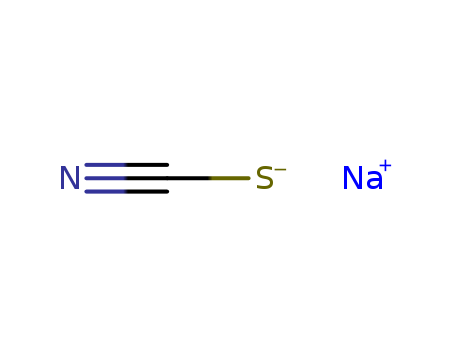
Sodium thiocyanate
- CasNo:540-72-7
Product Description
Factory supply Sodium thiocyanate 540-72-7 with sufficient production capacity
- Molecular Formula: NaSCN
- Molecular Weight: 81.0735
- Appearance/Colour: white crystalline powder
- Vapor Pressure: 2700mmHg at 25°C
- Melting Point: 287 °C (dec.)(lit.)
- Boiling Point: 146 °C at 760 mmHg
- Flash Point: 42.1 °C
- PSA: 49.09000
- Density: 1.295 g/mL at 20 °C
- LogP: 0.66498
Sodium thiocyanate(Cas 540-72-7) Usage
|
Preparation |
Sodium thiocyanate is prepared by boiling an aqueous solution of sodium cyanide with sulfur: NaCN + S → NaSCN. |
|
Reactions |
Sodium thiocyanate is an analytical reagent for measuring iodide. Other uses are dyeing and printing textiles, preparing thiocyanate salts, and nickel plating. Used in titrimetry. |
|
Air & Water Reactions |
Water soluble. |
|
Reactivity Profile |
Nitric acid violently oxidized a thiocyanate solution [Bretherick 1979 p. 121]. Caution should be exercised in treating a thiocyanate with an oxidizing agent such as a peroxide or chlorate as such mixtures have been known to explode. Special Hazards of Combustion Products: Irritating oxides of sulfur and nitrogen may form in fire [USCG, 1999]. Carbonyl sulfide is produced in a violent reaction by the mixture of sulfuric acid and Sodium thiocyanate. |
|
Health Hazard |
Inhalation of dust causes irritation of nose and throat. Ingestion of large doses causes vomiting, extreme cerebral excitement, convulsions, and death in 10-48 hrs.; chronic poisoning can cause flu-like symptoms, skin rashes, weakness, fatigue, vertigo, nausea, vomiting, diarrhea, confusion. Contact with eyes causes irritation. Prolonged contact with skin may produce various skin eruptions, dizziness, cramps, nausea, and mild to severe disturbance of the nervous system. |
|
Fire Hazard |
Special Hazards of Combustion Products: Irritating oxides of sulfur and nitrogen may form in fire. |
|
Flammability and Explosibility |
Nonflammable |
|
Safety Profile |
Poison by ingestion, intravenous, and subcutaneous routes. Moderately toxic by intraperitoneal route. Large doses taken internally cause vomiting, convulsions. Chronic poisoning is manifested by weakness, confusion, diarrhea, and skin rashes. When heated to decomposition it emits very toxic fumes of NOx, SOx, and Na2O. See also THIOCYANATES. |
|
Purification Methods |
It is recrystallised from EtOH or Me2CO, and the mother liquor is removed from the crystals by centrifugation. It is very deliquescent and should be kept in an oven at 130o before use. It can be dried in a vacuum at 120o/P2O5 [Partington & Winterton Trans Faraday Soc 30 1104 1934]. Its solubility in H2O is 113% at 10o, 178% at 46o, 225.6% at 101.4o; in MeOH 35% at 15.8o, 51% at 48o, 53.5% at 52.3o; in EtOH 18.4% at 18.8o, 24.4% at 70.9o; and in Me2CO 6.85% at 18.8o and 21.4% at 56o [Hughes & Mead J Chem Soc 2282 1929]. Sodium thiocyanate has also been recrystallised from water, acetonitrile or from MeOH using Et2O for washing, then dried at 130o, or dried under vacuum at 60o for 2days. [Strasser et al. J Am Chem Soc 107 789 1985, Szezygiel et al. J Am Chem Soc 91 1252 1987.] (The latter purification removes material reacting with iodine.) Sodium thiocyanate solutions can be freed from traces of iron by repeated batch extractions with Et2O. |
|
Physical properties |
Colorless crystals or white powder; deliquescent; melts at 287°C; very soluble in water; soluble in alcohol. |
|
Definition |
ChEBI: An organic sodium salt which is the monosodium salt of thiocyanic acid. |
|
General Description |
Odorless white solid. Sinks and mixes with water. |
InChI:InChI=1/CNS.Na/c2-1-3;/q-1;+1
540-72-7 Relevant articles
Microdetection of carbon in organic and inorganic compounds by ignition with sodium amide.
MOMOSE,UEDA,MUKAI
, p. 322 - 322 (1958)
-
COMPOUNDS CONTAINING HYDRIDO-TRICYANO-BORATE ANIONS
-
Page/Page column 52, (2013/02/28)
The present invention relates to compoun...
Kinetic study of an autocatalytic reaction: Nitrosation of formamidine disulfide
Francisco, Vitor,Garcia-Rio, Luis,Antonio Moreira, Jose,Stedman, Geoffrey
body text, p. 2292 - 2298 (2009/03/11)
The reaction kinetics for the acid nitro...
Recovery of sodium thiocynate from industrial process solution using nanofiltration technique
-
Page/Page column 6-11, (2008/06/13)
The present invention relates to a membr...
Vanadium nitride functionalization and denitrogenation by carbon disulfide and dioxide
Brask, Justin K.,Dura-Vila, Victor,Diaconescu, Paula L.,Cummins, Christopher C.
, p. 902 - 903 (2007/10/03)
A dramatic difference in behavior is obs...
540-72-7 Process route
-
-
16940-66-2
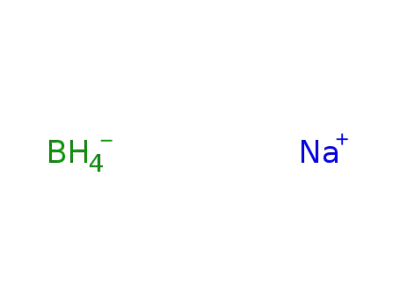
sodium tetrahydroborate

-
-
2K(1+) *Zn(2+) *4NCS(1-) =K2 {Zn(NCS)4}
-

-
333-20-0
potassium thioacyanate

-

-
potassium dicyanodihydridoborate
-
![K[HB(CN)3]](/upload/2026/9/e55046fa494d4b43942b4a24852b2fae_c96953c0-561b-401f-b1cd-eb42118af8aa.png)
-
K[HB(CN)3]
-

-
7783-06-4
hydrogen sulfide
-
-
540-72-7
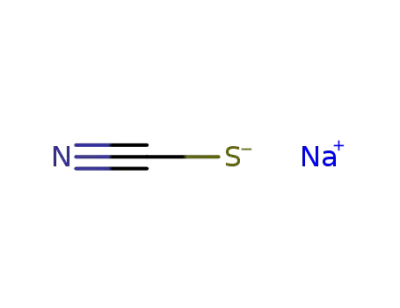
sodium thiocyanide
-

-
zinc sulfide
| Conditions | Yield |
|---|---|
|
at 185 ℃;
for 5h;
Under vacuum;
|
-
-
773837-37-9
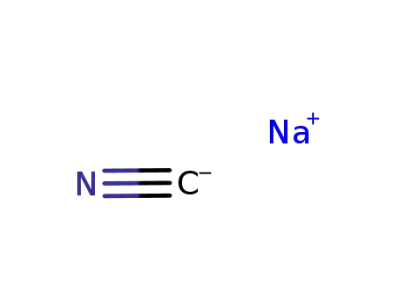
sodium cyanide
-
-
sodium tetrathiocarbonate *3H2 O
-
-
540-72-7
sodium thiocyanide
-
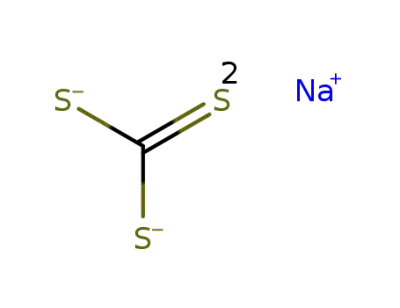
-
534-18-9
sodium trithiocarbonate
| Conditions | Yield |
|---|---|
|
In
water;
|
540-72-7 Upstream products
-
75-15-0

carbon disulfide
-
420-04-2
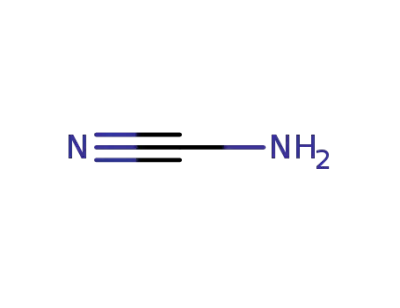
CYANAMID
-
143-33-9
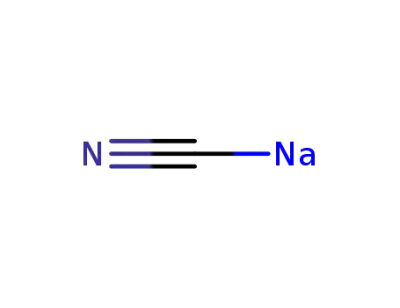
sodium cyanide
-
1147550-11-5
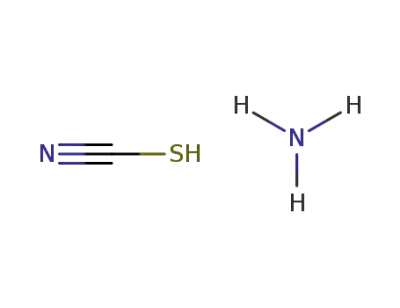
ammonium thiocyanate
540-72-7 Downstream products
-
24277-44-9

(1-isothiocyanato-ethyl)-benzene
-
79528-83-9

(3-thiocyanatopropyl)benzene
-
2290-65-5
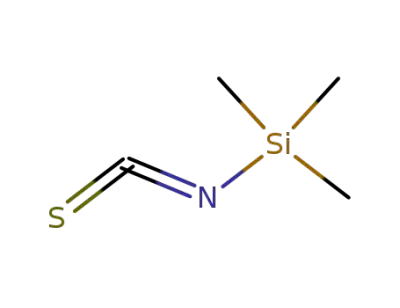
trimethylsilyl isothiocyanate
-
36234-62-5
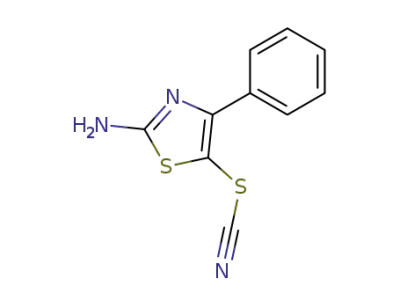
4-phenyl-5-thiocyanato-2-aminothiazole